
Buddha attained supreme enlightenment through meditation and then spent His whole life converting sentient beings. The Four Foundations of Mindfulness Sutra teaches a method of meditation to gain no-self, and to enter Nirvana.
From Reading About Buddhism to Practice: Begin Your Journey in Vietnam
Have you ever found yourself in this situation?
You have read many wonderful books about Buddhism, fascinated by articles on awakening, mindfulness, and the art of letting go. You have become familiar with profound philosophical terms such as Impermanence, Non-self, Dukkha, and the Four Noble Truths. You can speak at length with your friends about non-attachment and inner peace.
Yet, the moment you close the book and step back into the real world, a single criticism from your boss, a traffic incident on the road, or a delayed text message from your loved one can immediately ignite the flames of anger, irritation, and confusion within you. At night, you still toss and turn, unable to sleep amid a thousand worries, while feelings of loneliness and emptiness continue to gnaw at your heart.

Why is there such a vast gulf between what you know and how you live?
The answer is simple yet deeply meaningful: Reading about water cannot quench your thirst; reading a menu cannot satisfy your hunger; and reading about Buddhism can never replace the commitment to actual spiritual practice and meditation.
The Buddhist path is a path of rigorous practice and direct realization, where book knowledge must be refined into a living substance of the soul. And there is perhaps no place more ideal than Vietnam—a land imbued with the spiritual essence of Buddhist monastic life for thousands of years—for you to close the book and officially begin your journey of personal transformation.
1. The Paradox of Our Time: An Overload of Knowledge but a Barren Inner Life
Some people read extensively, grasp Buddhist teachings very quickly, and then write poetic, romantic passages about meditation for pleasure. Yet, when we look deeply into their inner lives, there is essentially nothing there. They have never endured hardship, never truly learned to collect and concentrate their minds, and never experienced even a single moment of the pure, peaceful essence of meditation. Such a person cannot truly be considered someone who deeply understands the Dharma.

We modern people are particularly susceptible to the “illusion of the intellect”:
- We mistakenly believe that understanding the concept of “letting go” means we have already learned to let go.
- We imagine that nodding in agreement with the truth of “impermanence” will prevent us from suffering when confronted with loss.
- We accumulate spiritual knowledge as if collecting material possessions, turning Buddhist teachings into tools for adorning the ego and making it appear more enlightened. Meditation is not like a computer: You cannot simply “cut” enlightenment from one teacher and “paste” it (copy and paste) into a student’s mind.
Knowledge can be borrowed from other people’s books, but the power of concentration, inner peace, and awakened wisdom can only arise when you personally cultivate them within your body and mind through persistent and demanding practice.
2. Buddhism Is a Path of Meditation and Committed Practice
To transform ourselves from “scholars who read books” into “practitioners who directly realize the truth,” we need to return to the fundamental roots of the tradition.
2.1. Through What Did the Buddha Attain Enlightenment?
Shakyamuni Buddha did not sit in a study writing philosophical treatises to discover the truth. He courageously renounced his royal throne, entered the deep forest, and spent 49 days and nights sitting motionless in meditation beneath the Bodhi tree, ultimately attaining supreme enlightenment.
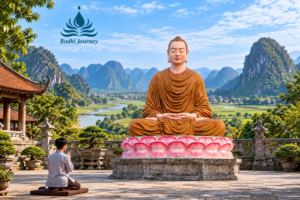
Our Original Teacher attained enlightenment through meditation. Today, we worship Him in the posture of meditation. If we claim to be followers who seek to return to the Buddha’s teachings but refuse to sit in meditation, merely wandering around the surface of written words, then we have never truly encountered the Buddha.
Meditation is the culmination of spiritual cultivation, the invisible bridge that allows our limited consciousness to touch the vast ocean of purity experienced by the enlightened ones.
2.2. Love Must Be Transformed into Practical Action
Studying Buddhism is not about escaping from life or withdrawing coldly into a corner of a room.
Chanting sutras and speaking words of love for all living beings are only the beginning. That love must be translated into concrete actions that serve the world, help others, and engage in meritorious and wholesome deeds.

When you practice correctly, “Wherever practice goes, happiness blossoms.” This is not a promise of some distant future life. It is a refreshing source of vitality, a deep and peaceful night’s sleep, and a smile of freedom and ease that naturally manifests in every moment of the present.
3. The Three Pillars of Transformation: Technique, Morality, and Merit
The journey of Buddhist practice is not simply a matter of crossing your legs and closing your eyes. It requires the harmonious integration of three solid pillars.
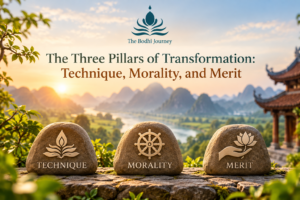
3.1. The Correct Technique of Full Lotus Meditation
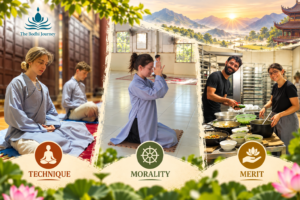
Sit upright and firmly, like a lotus throne. Relax all muscle groups, from the crown of your head to your heels. Gather your attention and observe the natural inhalation and exhalation without attempting to control your breathing. Allowing the breath to guide you, gradually quiet the restless inner dialogue of the brain and return your awareness to a calm, clear state, like a lake whose surface is completely undisturbed.
3.2. The Wisdom of Morality and Humility (Eroding the Ego)
The ultimate purpose of meditation is to eliminate the ego—the arrogant and selfish sense of “I.” Practitioners must continually learn to see themselves as small as a grain of sand, show reverence for the sages and the wise, and extend loving-kindness (Metta) to all living beings, wishing them well.
3.3. Cultivating Merit and Practicing Mindful Work
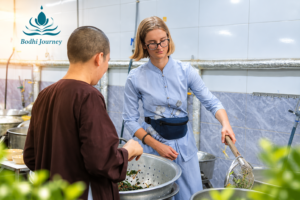
For the mind to settle easily into concentration, practitioners need the support of merit. Working together with the community to clean the monastery, care for green spaces, prepare vegetarian meals mindfully, or participate in charitable activities within the wider community can serve as a wonderful remedy for laziness and selfishness while cultivating wholesome energy that protects the mind and heart.
4. Why Is Vietnam the Perfect Destination to Begin Your Practice Journey?
Vietnam is not only home to magnificent natural landscapes that captivate the heart, but also one of the few countries in the world where the original spirit of Buddhism has been preserved, deeply intertwined with engaged meditation and the local way of life.
By joining mindfulness meditation retreats in Vietnam, you can step beyond the dry pages of theoretical knowledge and immerse yourself in a living environment of direct spiritual practice.
Profound Spiritual Encounters Along the Journey
Immerse yourself in sacred sites with thousands of years of history.
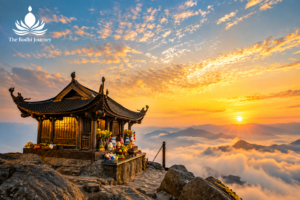
- Phat Quang Pagoda (Dinh Mountain, Ba Ria–Vung Tau): Hidden deep within a valley surrounded by vast bamboo forests and the gentle sounds of flowing streams, this is a cradle for disciplined practice of traditional meditation. Here, you will receive guidance in sitting meditation, beginning with the most fundamental techniques, while experiencing a harmonious communal lifestyle characterized by humility and wholehearted service.
- The Sacred Peak of Yen Tu (Quang Ninh): A thousand-year-old sacred site of the Truc Lam Zen tradition, founded by the Buddhist King Tran Nhan Tong. Amid towering mountains, drifting clouds, and ancient pine forests, each mindful step of walking meditation—Peace in Every Step—can awaken your determination and cultivate extraordinary powers of concentration.
- The Trang An–Bai Dinh Complex (Ninh Binh): A World Heritage landscape of magnificent green mountains and clear waters, where you can allow worldly worries to drift away with the crystal-clear currents.
- Tam Chuc and Dia Tang Phi Lai Pagodas (Ha Nam): Serene spiritual spaces nestled among expansive lakes and whispering pine-covered hills, inviting your mind and heart to return to their original simplicity and purity.
A Comprehensive Series of Practices to Transform Body and Mind
- Buddha worship and sutra chanting: Offer heartfelt reverence and noble aspirations to the enlightened and holy ones. Chant meaningful sutras that allow the profound principles of the Dharma to take root in your heart.
- Correct full lotus sitting meditation: Learn techniques for resting awareness in the whole body and mastering the practice of observing the natural breath.
- Traditional wellness Qigong: Stimulate the body’s energy channels, awaken inner strength, and release tension in the neck and shoulders caused by spending long hours at a computer. Strengthen your vitality to support your meditation practice.
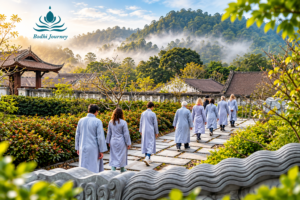
- Walking meditation in nature: Slowly experience each mindful step as your feet touch the earth beneath you in the tranquility of the early morning.
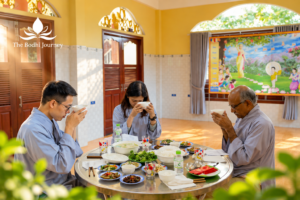
- Mindful vegetarian dining: Enjoy pure vegetarian dishes prepared with fresh, wholesome local produce, eating in silence and with gratitude for the gifts of nature.
- Monastic service and mindful work: Join the monastic community or lay Buddhists in ordinary daily tasks to cultivate merit and gradually diminish the burdens of an inflated ego.
- Tea conversations to untie psychological knots: Share an open and welcoming conversation over a fragrant cup of tea, where Buddhist monks, nuns, or meditation guides help you explore your concerns and inner conflicts through the perspectives of karma and the true Dharma, learning how to apply Buddhist teachings to everyday life.
5. Flexible Journeys Designed Around Your Needs
5.1. Half-Day and One-Day Retreats
- Locations: Hanoi and Ho Chi Minh City.
- Experience: An introductory program for busy travelers, offering the opportunity to learn proper sitting meditation techniques and experience mindful tea drinking.
5.2. Immersive Journeys of 2 to 4 Days
- Featured themed journeys: Path of Stillness, Peace in Every Step, The Power of Mind, and Healing Silence, held in Ninh Binh, Yen Tu, and Tam Chuc.
- These journeys help you undertake a comprehensive digital detox, cleanse your emotional burdens, and rediscover a profound connection with yourself.
5.3. Seven- to Eight-Day Monastic Life and Temple Lodging Experiences
- Stay directly at a monastery and immerse yourself in the serene lifestyle of monastic practitioners: waking up at 4 a.m., sitting in meditation amid the early morning mist, performing communal service, eating vegetarian meals, and observing precepts.
- This is a profound “soul surgery” experience designed to help you work through accumulated emotional wounds and establish a solid foundation of inner stability before returning to everyday life.
Conclusion: Close the Book and Take the First Step!
Knowing about the shore of liberation is precious. But if you are unwilling to board the boat and take up the oars, you will remain forever a spectator standing on the shore of suffering.
Do not allow Buddhism to remain confined to books sitting on a shelf or to fruitless intellectual debates. Give yourself the opportunity to engage in genuine practice at least once: sit down on a meditation cushion, listen to the rhythm of your own breathing, and allow stillness to wash away the dust of the world.
The greatest journey of a human life begins with one courageous step back toward oneself.
And the peaceful, spiritually rich land of Vietnam is always ready to welcome you with open arms!
Related articles
Do You Truly Understand Yourself? Buddhism and the Journey of Observing the Mind
Try taking a moment of silence to ask yourself: Do you truly understand the person living within you?...
See more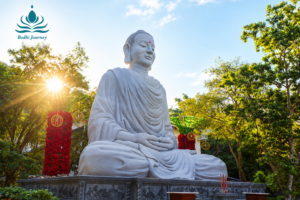
A Beginner’s Guide to Buddhism: What Is Buddhism Really About?
In the eyes of many Westerners, Buddhism is associated with ancient temples, images of contemplative monks, and abstract...
See more
What Is Mindfulness Meditation?
Today, many people are eager to understand “what is mindfulness meditation?”. Busy and stressful modern life has led...
See more
What are the 3 Inspiring Ultimate characteristics of Buddhist meditation Vietnam?
Buddhist meditation Vietnam has developed its own unique identity, making significant contributions to the nation’s culture, philosophy, and...
See more
