
Buddha attained supreme enlightenment through meditation and then spent His whole life converting sentient beings. The Four Foundations of Mindfulness Sutra teaches a method of meditation to gain no-self, and to enter Nirvana.
A Beginner’s Guide to Buddhism: What Is Buddhism Really About?
In the eyes of many Westerners, Buddhism is associated with ancient temples, images of contemplative monks, and abstract scriptures.
Yet, in the 21st century, amid the extraordinary development of technology and the fast pace of modern life, an increasing number of scientists, psychologists, businesspeople, and young people around the world are turning to Buddhism as a path to self-discovery and the cultivation of inner peace.
So, what is Buddhism really about? Is the Buddha a deity or a real historical figure? And why do teachings that are more than 2,500 years old still hold meaning for people today?
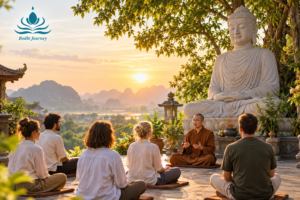
Let us explore Buddhism through simple, relatable, and experiential practices offered by Mindfulness Meditation Retreats in Vietnam.
1. Who Was the Buddha? A Real Human Being, Not a Deity
One of the fundamental differences between Buddhism and many other religions is that the Buddha is neither a creator god nor a deity who bestows blessings or inflicts misfortune, but a real historical figure.
Shakyamuni Buddha, whose birth name was Prince Siddhartha Gautama, was born around the 6th century BCE. Although he lived in luxury and privilege, he was deeply troubled by the suffering inherent in human life: Birth, Aging, Sickness, and Death. Therefore, he renounced his royal life in search of enlightenment and liberation from suffering.
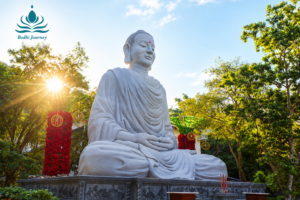
After many years of spiritual practice, he attained enlightenment beneath the Bodhi tree. The word “Buddha” means “The Enlightened One” or “The Awakened One.”
The Buddha was a spiritual teacher who showed the way to overcome greed, hatred, and delusion. He did not offer salvation to others but taught each person to practice, transform themselves, and discover their own path to liberation.
2. What Is Buddhism Really About? A Simple, Non-Dogmatic Understanding
Setting aside layers of profound philosophical thought, if we were to summarize Buddhism into its most essential and accessible values for everyday life, Buddhism would be:
2.1. A Path of Wisdom and Mindful Awareness
Buddhism does not require you to “believe blindly.” The Buddha’s famous teachings to the Kalama people have become a guiding principle: Do not be quick to believe anything simply because it is an ancient tradition, because it is written in scriptures, or because it is taught by a famous spiritual master. Experience it for yourself. If you find that it brings benefits and peace to yourself and others, then believe in it and put it into practice.
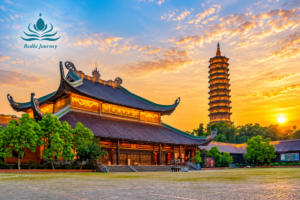
Buddhism views the human mind as a mirror. When the mirror is covered by the dust of greed, hatred, and delusion, we see the world through a distorted lens and experience suffering. Learning Buddhism is simply the process of wiping the dust from the mirror of the mind so that we can see all things as they truly are.
2.2. The Science of Cause and Effect — You Are the Architect of Your Own Destiny
Buddhism does not believe in a predetermined destiny or divine punishment. Instead, the entire universe operates according to an objective principle: the Law of Cause and Effect.
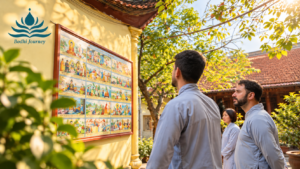
- Every thought, word, and action we create (the cause) eventually contributes to shaping our life circumstances and mental states (the effect).
- Wholesome thoughts, good deeds, and helping others create a positive field of energy, blessings, and deep inner confidence.
- Harboring malicious, selfish, or deceptive intentions naturally leads to anxiety, fear, and suffering.
This principle restores the power to shape your own destiny: No one can make you suffer except your own unwise actions, and no one can bring you everlasting happiness except your own efforts to cultivate goodness.
2.3. A Way of Life Rooted in Compassion and Humble Morality
Buddhism does not teach people to turn away from the world. Instead, it teaches us how to love the world with an expansive heart:

- Recognize the suffering of others as if it were your own, responding with compassion and support.
- Keep your heart humble, like a grain of dust before the vast universe, letting go of arrogance and wounded pride.
- Cherish every drop of water, every piece of bread, and every tree and blade of grass around you.
3. Why Are People in the Digital Age Turning to the Buddha’s Teachings?
In an era when people enjoy more material conveniences than ever before in history, why are anxiety, depression, and mental exhaustion spreading so rapidly?
This is when the world begins to realize that technological progress can provide external material comforts but remains powerless to resolve the inner conflicts of the human soul. People are turning to Buddhism because of its timeless healing values.
3.1. Meditation — A Form of “Mental Hygiene” That Quiets the Noise of the Mind
People today are constantly surrounded by two layers of noise: external noise (traffic horns, news, and computer notifications) and internal noise (racing thoughts, worries, and regrets).
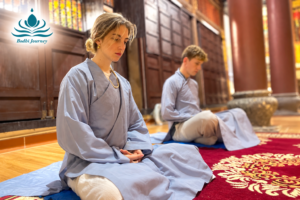
Buddhist meditation offers a systematic and disciplined method for training the mind:
- By sitting upright in the full lotus position, relaxing all your muscles, and observing your natural breathing, you bring your awareness back to the anchor of the present moment.
- As the mind settles on the breath, the stream of chaotic thoughts can gradually quiet down. The nervous system can move out of a state of stress, while the body engages its natural restorative processes, bringing a profound sense of inner bliss (meditative joy) that does not depend on material possessions.
3.2. Letting Go of the “I” (Ego) to Release the Burden of Exhaustion
One of the greatest challenges facing modern people is the pressure to “prove themselves,” the fear of being judged, and the habit of comparing themselves with others on social media.

The Buddha’s teachings on Impermanence and Non-Self remind us that our bodies, reputations, and emotions are all constantly changing processes. When you understand that there is no permanent “self” that you must strain to protect, you can let go of wounded pride, remove your exhausting masks, and live with a profound sense of lightness and freedom.
3.3. Understanding the Nature of Suffering and the Path to Liberation
The Four Noble Truths taught by the Buddha are not a pessimistic philosophy but rather a precise diagnosis of the human condition:

- Recognize the suffering that exists in our lives (the Truth of Suffering).
- Identify its root causes, including attachment, greed, and selfishness (the Truth of the Origin of Suffering).
- Affirm that suffering can indeed cease, allowing us to attain peace and happiness (the Truth of the Cessation of Suffering).
- Follow a practical path of ethical conduct, meditation, and wisdom to achieve freedom (the Truth of the Path Leading to the Cessation of Suffering).
4. Go Beyond Books: Experience Living Buddhism Through Mindfulness Meditation Tours in Vietnam
Buddhism is not merely a collection of theories to be debated intellectually at a desk. It is a way of life that must be experienced through the whole body and mind.
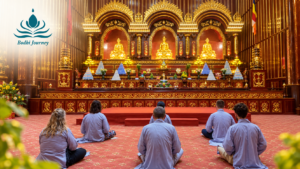
For international visitors and beginners, traveling to Vietnam—a land whose culture has been deeply influenced by more than two thousand years of Buddhist teachings and peaceful values—offers a wonderful opportunity to experience Buddhism in an authentic and vivid way.
Conclusion: Embark on a Journey to Discover Your Own Inner Light
Buddhism does not require you to change your nationality, abandon your family, or worship an unfamiliar faith. It simply offers you a map of wisdom to help you understand yourself more clearly, let go of trivial attachments, and live a peaceful life filled with compassion.
The Buddha once taught:
❝Be a lamp unto yourselves. Rely on yourselves and do not depend on anything else.❞
Allow yourself to slow down, open your heart to embrace the wisdom of thousands of years, and personally experience that extraordinary peace amid the beautiful natural surroundings of Vietnam!
Related articles
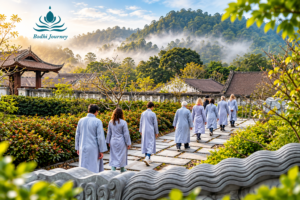
From Reading About Buddhism to Practice: Begin Your Journey in Vietnam
Have you ever found yourself in this situation? You have read many wonderful books about Buddhism, fascinated by...
See more
Do You Truly Understand Yourself? Buddhism and the Journey of Observing the Mind
Try taking a moment of silence to ask yourself: Do you truly understand the person living within you?...
See more
What Is Mindfulness Meditation?
Today, many people are eager to understand “what is mindfulness meditation?”. Busy and stressful modern life has led...
See more
What are the 3 Inspiring Ultimate characteristics of Buddhist meditation Vietnam?
Buddhist meditation Vietnam has developed its own unique identity, making significant contributions to the nation’s culture, philosophy, and...
See more
