
Buddha attained supreme enlightenment through meditation and then spent His whole life converting sentient beings. The Four Foundations of Mindfulness Sutra teaches a method of meditation to gain no-self, and to enter Nirvana.
Do You Truly Understand Yourself? Buddhism and the Journey of Observing the Mind
Try taking a moment of silence to ask yourself: Do you truly understand the person living within you?
Most of us would quickly smile and answer: “Of course! I have lived with this body and this mind for decades. How could I not understand myself?” We know our food preferences, clothing styles, musical tastes, where we like to travel, and what kinds of people we dislike. We even have an impressive résumé filled with qualifications, professional expertise, and social achievements to be proud of.

Yet, have you ever suddenly found yourself overwhelmed by moments of profound confusion in your life?
Human eyes can see everything in the world, from towering mountains and flowing rivers to the faces of countless people around us. But there is something strange: those very eyes can never see themselves directly. The human mind is much the same. We accumulate profound knowledge and thoroughly analyze events happening around the world, yet our own inner world remains the most mysterious, unfamiliar, and obscure territory of all.
So, how can we lift the veil of this mystery? Buddhism, with its thousand-year-old treasury of methods for contemplating the mind, offers you the key to embarking on a journey of observing yourself with the greatest possible honesty and completeness.
1. The Trap of Misconception: “I Already Understand Myself, and I Am Already a Good Person”
One of the greatest mistakes most people make is constantly believing that they are already good and understand everything about themselves.
- When someone asks, “How is your life?”, we can easily reply, “I live a very happy life, harm no one, and treat everyone kindly.”
- But this is merely a superficial layer on the surface when the sea is calm and the waves are still. Only when adversity strikes—when our dignity is insulted, when we lose our possessions, or when we face temptations of fame and wealth—do the dark corners hidden deep within our subconscious rise to the surface: greed, hatred, selfishness, fear, and a prideful ego.

Because our five physical senses (eyes, ears, nose, tongue, and body) are constantly swept along by external circumstances, we spend our time finding fault with others and judging the world. We rarely turn our awareness (the mental faculty) inward to examine: What is my mind plotting right now? Is it wholesome or unwholesome? Is it humble or complacent?
To repair a machine, a mechanic must dismantle its components to identify the exact source of the problem. To transform our lives, we must have a method of “opening up the mind” so that we can clearly see the hidden faults within ourselves.
2. The Journey of Observing the Body and Mind According to the Buddha’s Teachings
In Eastern meditation traditions, turning inward to observe oneself is the fundamental responsibility of a practitioner. It is something that cannot be found or borrowed from anyone outside oneself.
So, what exactly do we observe when we observe ourselves? Human beings are composed of two fundamental aspects: the Body and the Mind. According to the teaching of the Four Foundations of Mindfulness (Satipatthana), the journey of observing the mind unfolds through increasingly profound layers of awareness.
2.1. Contemplation of the Body — Seeing the Impermanence of the Four Elements
The first step in meditation is to return to awareness of the whole body:
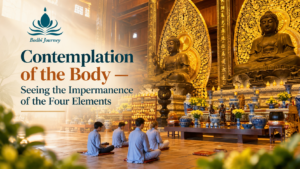
- Recognize the uprightness of the spine, relax both shoulders, and feel each gentle breath flowing in and out without trying to control it.
- When we become firmly grounded in awareness of the body, we realize that this physical form is merely a temporary combination of four elements—earth, water, air, and fire—that may exist today and disappear tomorrow. Seeing the fragile and impermanent nature of the body helps us become less preoccupied with catering to it and less demanding of luxurious material pleasures.
2.2. Contemplation of Feelings — We Are Merely Changing Sensations
Going one layer deeper, you may be surprised to discover that what we call “ourselves” is, in reality, largely made up of feelings and sensations (vedana).
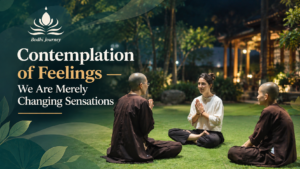
- Painful sensations, pleasant sensations, sadness, excitement, joy, and delight…
- Throughout our lives, we are controlled and manipulated by these feelings like puppets. Whenever pleasure arises, we become attached and chase after it. Whenever suffering arises, we become irritated and try to push it away.
- When you sit quietly and observe, you become a witness standing apart from the stream of feelings as they pass by. You recognize their arising, their presence, and their eventual disappearance, like waves on the surface of the ocean, without allowing yourself to be swept away by them.
2.3. Contemplation of the Mind — Stepping Outside Your Own Mind to See It Clearly
There is a fascinating psychological principle:
An old saying goes, “We see others clearly but are blind to ourselves.” An outsider is often more clear-sighted than someone directly involved. To understand our own mind, we must learn to step back from it and observe it as an independent witness.
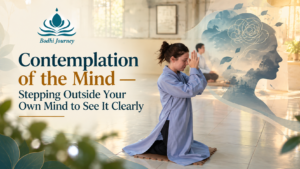
Through seated meditation in the full-lotus posture and by maintaining mindful awareness:
- You observe each stream of thought as it arises and fades away.
- You clearly recognize pride arising when you receive praise, wounded self-esteem emerging when you are criticized, and anxiety creeping in when you face challenges.
- You neither judge nor suppress these experiences; you simply and quietly recognize them. When you become aware of these subtle movements, the darkness of ignorance naturally begins to dissolve, making way for equanimity and clear wisdom.
3. Understanding Yourself to Enter the Realm of “Non-Self”
The ultimate purpose of observing the mind in Buddhism is fundamentally different from that of conventional psychological therapies. Buddhism does not teach you to observe the mind in order to embellish the ego or cultivate a selfish form of self-love.
What do we seek to understand the mind for? To see that even this restless, invisible, ever-changing mind is, in truth, “not really ours.” This body is not truly ours, and neither is this mind. When we fully penetrate the truth of NON-SELF (Anatta), the heavy burden of the ego naturally falls away. This is when the door to genuine liberation swings open, and our hearts are refreshed by boundless universal love and compassion for all living beings.
4. Awakening Mindful Awareness Through Spiritual Meditation Retreats in Vietnam
Amid everyday life, filled with work pressures, incessantly ringing phone notifications, and countless worries, it is difficult for an ordinary person to stop and create enough inner space to observe their own mind deeply.
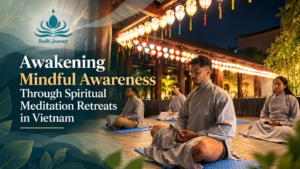
This is precisely why Spiritual Meditation Retreats are designed: to provide a peaceful refuge where you can temporarily step away from the noisy outside world and embark on a sacred journey of dialogue with your own soul.
Conclusion: The Courage to Look Within and Live with Inner Freedom
The world will never stop turning, and life’s demands will never come to an end. But when you learn to pause and courageously pick up the mirror of meditation to reflect upon and understand yourself, you will no longer be swept away by storms of emotion.
You will step back into the world with a peaceful smile, an open and compassionate heart, and a steady inner strength that enables you to love and contribute to life as fully as possible.
From Reading About Buddhism to Practice: How Can Beginners Start Meditating? Let’s explore this in the next article!
Related articles
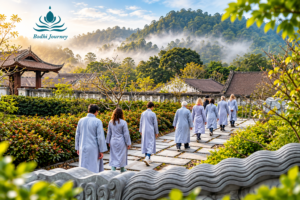
From Reading About Buddhism to Practice: Begin Your Journey in Vietnam
Have you ever found yourself in this situation? You have read many wonderful books about Buddhism, fascinated by...
See more
A Beginner’s Guide to Buddhism: What Is Buddhism Really About?
In the eyes of many Westerners, Buddhism is associated with ancient temples, images of contemplative monks, and abstract...
See more
What Is Mindfulness Meditation?
Today, many people are eager to understand “what is mindfulness meditation?”. Busy and stressful modern life has led...
See more
What are the 3 Inspiring Ultimate characteristics of Buddhist meditation Vietnam?
Buddhist meditation Vietnam has developed its own unique identity, making significant contributions to the nation’s culture, philosophy, and...
See more
