
Buddha attained supreme enlightenment through meditation and then spent His whole life converting sentient beings. The Four Foundations of Mindfulness Sutra teaches a method of meditation to gain no-self, and to enter Nirvana.
Can You Learn to Be Alone Without Feeling Lonely?
In an age of explosive social media growth and the fast-paced rhythm of urban life, human beings seem to be suffering from a common ailment: the fear of being alone. All it takes is an evening without plans, a weekend without the sound of laughter, or an unexpected moment of silence within four walls for emptiness to immediately rush in and overwhelm the heart.

But have you ever asked yourself: Is it possible to spend hours, days, or even years alone while the soul remains filled with joy, warmth, and peace—a state in which loneliness is completely absent?
The answer is: Absolutely. But this is not a form of passive escapism. Rather, it is a profound art of inner cultivation that Buddhism has developed and refined over thousands of years.
1. Understanding the Difference: “Being Alone” Does Not Mean “Being Lonely”
To learn how to be peacefully alone, the first step is to clearly distinguish between two states that are often mistaken for one another:

- Being alone (Solitude): This refers to an external, physical circumstance. It simply means that there are no other people around you. Your body is alone in a room, in a corner of a garden, or amid the mountains and nature.
- Loneliness: This is a painful mental state, a deep-rooted fracture within the soul. It is the feeling of being lost and empty, of being rejected by the world, of feeling that no one understands you and that you cannot find anyone worthy of your love.
A great Buddhist master who has lived in seclusion for many years in a remote, snow-covered forest may have no one around, yet the master’s heart remains filled with joy, purity, and boundless love for all beings. This is a person who is alone but never lonely.
Conversely, some people raise their glasses at luxurious parties, surrounded by dozens of familiar faces, yet their hearts feel as cold as if they were standing in a desolate desert. These are people who are lonely even in the midst of a crowd.
Thus, loneliness does not depend on how many people are around you, but rather on the state of your inner consciousness when you face yourself.
2.The Trap of Being Alone: The Rise of the Ego and Deluded Thoughts
Why do most modern people quickly fall into distress and loneliness when they are alone?
In Buddhist teachings on moral psychology, there is a subtle yet dangerous spiritual principle: without dedicated spiritual practice, being alone does not diminish the human ego. On the contrary, the ego can grow significantly stronger.

- The trap of “inner monologue”: When we are among other people, we must exercise restraint, listen, and make concessions to others. These interactions unintentionally help keep our egos in check. But when we retreat alone into a dark corner, we begin to fall into an endless stream of inner monologue. We talk to ourselves in our minds, invent imaginary scenarios, and revisit old wounds, eventually giving rise to resentment, self-pity, or unrealistic ambitions.
- The inflation of ego-clinging: When we live only for ourselves and constantly think about ourselves, the ego—the attachment to the self—gradually grows. Our minds become trapped in self-centered questions: “Why do people treat me this way?” “Why is my life so unfortunate?” The more we think about ourselves, the more our inner world shrinks into a suffocating prison. At that point, loneliness becomes the immediate consequence of selfishness and uncontrolled delusion.
Understanding this, we realize that to be alone without feeling lonely, we cannot simply follow our instincts or allow our minds to wander unchecked. We must learn how to manage and transform our consciousness.
3. Four Steps to Practicing the Art of Being Alone in Complete Peace and Joy
Guided by the teachings of karma and meditation, you can gradually develop the ability to befriend yourself through the following four core practices:
- Use Meditation to Tame the Silence
It is natural for ordinary people to fear solitude. When forced to be alone, without dedicated spiritual practice, the mind can immediately fall into the dangerous trap of “inner monologue”—restless thoughts, deluded comparisons, and an expanding ego that create a chaotic noise within. As a result, a once-quiet space suddenly becomes suffocating and frightening.

To escape this fear, we cannot rely on social media or artificial external noise. The only genuine path is to use meditation to tame the silence. Through meditation, we courageously enter a state of complete solitude, letting go of external concerns and turning our attention inward, into the depths of our consciousness. We learn to see clearly our own mistakes, impermanence, limitations, and imperfections.
By focusing the mind on each breath, relaxing the entire body, and maintaining a humble attitude, the inner disturbances and silent dialogues in our heads will gradually subside. When the noise within finally fades away, the power of concentration develops, bringing forth an innate, purified joy known in Buddhism as the bliss of meditation (jhāna-pīti). It is a wonderful, refreshing state of peace that does not depend on any lively social interaction.
With the strength of meditation, solitude is no longer a sentence of exile or an overwhelming experience of loneliness. Instead, it becomes a stable inner sanctuary where we can cultivate our inner strength and nurture boundless love for all beings.
- Expand Loving-Kindness and Compassion—The Body Is Alone, but the Heart Embraces All Beings
One wonderful secret to never feeling isolated is this: never allow your mind to shrink into the narrow confines of the ego.

+ When sitting alone in your room, close your eyes and extend your loving-kindness to everyone. Wish for your parents, loved ones, and friends, as well as the poor and sick in society, to enjoy peace, abundance, and enlightenment.
+ Extend your compassion even to plants, animals, and unseen beings.
+ When your heart expands to embrace the entire sky and all living beings, the energy of love will fill your entire living space. At that moment, although you are sitting alone, you will feel a sacred connection with the entire universe. Those whose hearts are filled with boundless loving-kindness will never truly know loneliness.
- Live a Life of Gratitude and Kindness—Be Willing to Endure Hardship for Others When Engaging with the World
The Law of Karma teaches that: “Betraying the kindness of others is the cause; loneliness is the result.”
Fundamentally, people who feel lonely when alone are experiencing a blockage in the flow of kindness and affection between themselves and the world. If you want your heart to remain warm when you are alone, then in your everyday life:

+ Actively sow the seeds of kindness and gratitude. Be willing to make sacrifices and help others through concrete actions, without calculating what you might gain in return.
+ When stepping out into society, do not shy away from difficulties or hardship. Be kind, consider the needs of others, and be willing to endure hardship for the common good.
+ Someone who has devoted an entire day to helping others will return to their room alone at night with a heart filled with blessings and peace of mind. The light of the good deeds they have performed will warm their soul, transforming a quiet, still space into a place of absolute peace and rest.
- Cultivate Discipline in Daily Life: Do Not Let an Idle Mind Give Rise to Unwholesome Thoughts
An ancient teaching states: “Idleness breeds wrongdoing.” When we are alone without engaging in anything useful, the mind can easily slip into gloom and delusion.

+ Turn your time alone into an opportunity for self-improvement: read books that cultivate moral character, learn new knowledge, keep your living space clean and tidy, care for a potted plant, or engage in gentle exercise.
+ Minimize the habit of scrolling through social media on your phone while lying alone. Social media creates only an illusion of connection and can intensify comparison, envy, and emptiness once the screen goes dark.
Conclusion: Being Alone Is a Journey Back to Yourself, Enabling You to Love More Deeply
Learning to be alone without feeling lonely is not about promoting an eccentric lifestyle, withdrawing from the world, or becoming complacent in the belief that “I don’t need anyone.” On the contrary, it is a profound mental strength that allows us to build a firm foundation within ourselves.

Once you can smile peacefully amid silence and solitude, you will no longer enter relationships with a mindset of clinging, demanding, or fearing loss. You will approach others not to “beg” for attention to fill the emptiness of loneliness, but as someone whose heart is already full of love and who is ready to share it.
Learning to be alone mindfully is a sacred resting place where we can renew our souls before stepping back into the world and embracing humanity with pure, boundless love.
And how can meditation help us feel less lonely? In the next part, we will explore this question in greater depth!
Related articles

5 Most Important Things to Know About Guided Meditation Retreats Vietnam
Have you ever heard of guided meditation retreats Vietnam? These retreats can be the key to opening the...
See more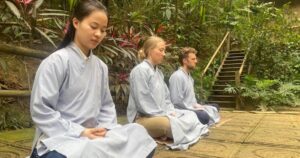
3 Top features of meditation tours cultural experiences Vietnam
Meditation tours cultural experiences Vietnam blend mindfulness Meditation practices with deep cultural immersion featuring stays at serene locations...
See more
4 most outstanding features of Buddhist mindfulness retreats for peace in Vietnam
Buddhist mindfulness retreats for peace in Vietnam have emerged as an appealing destination for international visitors. In a...
See more
THE 7 BEST VIETNAM MINDFULNESS RETREATS FOR 2026
Vietnam is not only a peaceful country blessed with stunning landscapes but also one of the great destinations...
See more
