
Buddha attained supreme enlightenment through meditation and then spent His whole life converting sentient beings. The Four Foundations of Mindfulness Sutra teaches a method of meditation to gain no-self, and to enter Nirvana.
Meditation and Mindful Living Tips for a Calm, Balanced Life
Wonderful meditation and mindful living tips for a Calm, Balanced Life are incredibly valuable for anyone living in today’s high-pressure society filled with negativity. Many people feel completely exhausted and are searching for ways to heal their minds, yet they have not found a method that is truly effective or able to address the root causes.
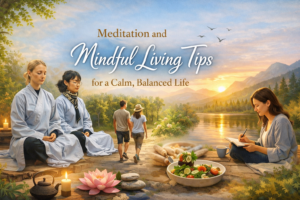
Let’s explore what meditation and mindful living tips for a Calm, Balanced Life really look like.
1. Meditation and Mindful Living Tips: The most effective tips for practicing meditation correctly
Practicing meditation correctly brings many benefits, because meditation is not only the method practiced by the Buddha Shakyamuni, who meditated for 49 days and attained Supreme Enlightenment, but it is also an effective way to reduce stress, restore balance in life, rediscover yourself, and gain clearer direction in life. When exploring Meditation and Mindful Living Tips for a Calm, Balanced Life, the first thing you should learn is the most effective way to practice meditation correctly, following the basic meditation techniques outlined below.
-
The basic meditation technique in Meditation and Mindful Living Tips :
First, sit in the full lotus position.
Second, keep the body still and relaxed.
Third, abide in the body and be aware of all of it.
Fourth, contemplate the impermanence of the body.
Fifth, notice (but do not control) your breathing in and out.
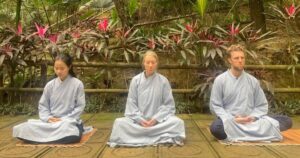
These five things are all effective in resolving our unwanted thoughts. The principle of practicing meditation is to use a combination of many things to purify the mind. We must memorize and practice all these things.
+ The first is to sit in the full lotus position (all Buddhas of the past, the present, and the future, do it). You sit upright with your shoulders level and comfortable, place your left hand in your right hand, palms upwards. At that time, your two soles, two palms, and lower abdomen (with the CV4 Acupuncture Point inside) are considered to be located in the same place, corresponding to the five parts of the mind: one part for the lower abdomen, two parts for two palms, and two parts for two soles. Only in the full lotus position, can these five parts of the mind be gathered together? The heart and the head do not count as parts of the mind in practicing meditation.
+ The second is to keep the body still and relaxed. If the body is stiff, the brain will be tense; if the body isn’t still, the mind cannot be calmed. Therefore, keeping the body still and relaxed means keeping the mind calm (= to have fewer unwanted thoughts). Following Buddha’s path, we should treat the body as the root of the mind, and it’s the golden rule of the practice of meditation. Later, when we progress in meditation, we will find that we should never leave the body, at the beginning as well as at the end of our spiritual practice.
+ The third is to abide in the body and be aware of all of it. When we pay much attention to the body, the brain will be less active. So, abiding in the body and being aware of all of it is a powerful technique to quiet the mind, subduing strong unwanted thoughts. Don’t pay attention to the outside world but the whole body, from head to toe. Always correct the position of all parts of the body. Though you should be aware of the whole body, pay more attention to the abdomen (especially the bottom of the abdomen where the CV1 Acupuncture Point is located) and the legs and feet. We should be aware of it gently but not forcefully. The CV1 Acupuncture Point is located at the bottom of the abdomen but is responsible for the head. When it is strong, the brain will work very well, and thus we will become more intelligent and be easier to see our hidden mistakes, and after a long time, we will have intuition.
Besides, we need inner strength or inner power (from our practice of qigong) to be able to abide in the body and be aware of the whole body regularly. Those who possess great inner strength always feel their life energy, so they’re easy to remember their whole bodies. Inner strength helps nourish the brain.
Practicing qigong is to strengthen the part of the body from the navel down to the bottom of the abdomen, where there are three extremely important points: the CV4 Acupuncture Point, the CVI Acupuncture Point, and the sacral. The sacrum is the yin root of the body, the place where one’s inner strength is located and grown.
At the beginning of the practice of meditation, we were instructed “sit in the full lotus position; keep the body still and relaxed; abide in the body and be aware of it,” now you should be gently aware of the sacrum also (right at the sacrum, no higher that). Our inner power will gradually appear and it will support our practice of meditation.
+ The fourth is to contemplate the impermanence of the body. When we’re well aware of our bodies, our
minds will have few unwanted thoughts our bodies will be stable, and our inner strength will be full, and thus, our attachment to the body will appear. Being attached to the body is also being attached to the self, and that’s why Buddha teaches us to contemplate the impermanence of the body, setting up the foundation to eliminate the self.
In the Kayagatasati-Sutta, Buddha carefully teaches how to contemplate the body: the practitioner must see the change of the body from young to old, ugly, and sick, and then die, and then the body continues to decay, its bones also dissolve into ashes, then the ashes completely disappear. We have to do it to totally remove our attachment to the body. You see, Buddha’s thoroughness, rigor, subtlety, wisdom, and compassion are incomparable, and thus our reverence for Him will be never sufficient.
+ The fifth is to notice (but not control) your breathing in and out.
Breathing is the core of meditation, anyone who practices meditation must understand the meaning of breathing very well.
We breathe to sustain our lives, and breathing has two kinds: automatic breathing and active breathing. Automatic breathing means that even though we are not paying attention to our breathing, our bodies still breathe automatically, controlled by the unconscious nervous system. If we pay attention to our breathing (active breathing), it will immediately be controlled by the conscious nervous system.
Neuroscience has confirmed that when we breathe consciously (active breathing), our brains will immediately be focused and have few unwanted thoughts. This is a great property of man. In terms of medicine, we can say when the neural area responsible for breathing gets excited, other neural areas will go into inhibition.
-
Three solid foundations of meditation in Meditation and Mindful Living Tips
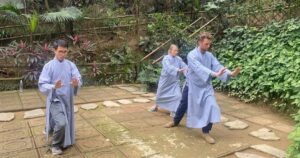
Alongside this, in order for our practice of meditation to be successful, we must first prepare three solid foundations: morality, blessings, and qigong.
+ Morality is the purity of the mind, with solute reverence for Buddha, boundless love for sentient beings, and extreme humility.
+ Blessings come from our efforts to bring peace, happiness, and morality to everyone.
+ Qigong helps to keep our life energy in the lower part of the body, helping the brain to be stable when we practice meditation.
2. Meditation and Mindful Living Tips for a Calm, Balanced Life: Mindful Living Tips
Mindfulness Living in Mindful Living Tips for a Calm, Balanced Life is defined as living in a serene and compassionate way.

Living serenely means not allowing ourselves to be swayed by the ups and downs of life. We know to stay away from excessive excitement, agitation, noise, excessive desires, and various sensations.
Life is filled with adversities and obstacles, and sometimes it also brings rewards from past merits. People are constantly subjected to the vicissitudes of life. With Meditation and Mindful Living Tips for a Calm, Balanced Life, A practitioner of meditation must maintain a calm mind, not suffering when encountering unfortunate events and not becoming overly elated when encountering favorable circumstances. One must remain equanimous in the face of life’s joys and sorrows in order to discover the happiness of meditation, which is boundless and pure joy.
Throughout life, people try to replace suffering with worldly pleasures. However, both suffering and worldly pleasures ultimately bring sorrow to individuals. with Mindfulness practices for daily life, Meditators must detach themselves from this cycle of sorrow and discover the true happiness that comes from meditation. These two forms of happiness are distinct from one another.
We must contemplate carefully in order to make a determination to follow the path of the Buddha’s teachings and escape the vicissitudes of life.
Life also offers various forms of entertainment. Although they are called entertainment, in reality, every activity stirs the mind. Gambling, alcohol, sex, drugs, obscene movies, as well as various forms of fighting such as boxing, cockfighting… are the most obvious sinful pastimes. Countless acts of evil arise from these dark amusements, burying many people in deep abysses of suffering. The law of karmic retribution will compel them to face the consequences in the future.
Then there are seemingly wholesome forms of entertainment that gradually unsettle the mind and erode morality. For example, excessive enthusiasm in football, violent computer games, intimate dancing between men and women, stimulating music, revealing clothing… all contribute to the deterioration of the soul. We are grateful to the Buddha for establishing moral guidelines to protect practitioners from these forms of entertainment that disturb the peace of mind. Even playing chess, which seems to enhance intellect, actually consumes a great deal of mental energy and time. Except for composing poetry and music to contribute to the propagation of morality, any other form of artistic expression that serves to convey personal emotions also agitates the mind. In general, with Meditation and Mindful Living Tips for a Calm, Balanced Life, meditators must assess what causes the loss of their inner serenity and know how to avoid and refrain from it.
For those at an advanced level, they can achieve a mind that is consistently undisturbed, not just serene.
-
Meditation and Mindful Living Tips for a Calm, Balanced Life: Living with compassion
– Living with compassion in Meditation and Mindful Living Tips means living with love and responsibility towards life.
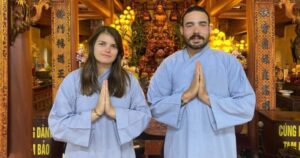
While we must keep ourselves away from the distractions and entanglements of worldly life, meditators are actively engaged in contributing love and compassion to the world. Living serenely and living with compassion are contrasting qualities, but they are both important elements that make up an authentic meditative life. Meditators must harmonize these two ways of living beautifully throughout their lives.
– They always cultivate a heart that embraces love for all beings in Meditation and Mindful Living Tips for a Calm, Balanced Life

Even when they are not actively doing anything, that love is present and abundant within their hearts, alongside inner peace. And whenever there is an opportunity, meditators always offer assistance to others, whether it is a small act like picking up someone’s shoes or a grand endeavor like organizing moral education for street children…
–Those who live with compassion in Meditation and Mindful Living Tips rarely harbor negative thoughts about others, even if there are disagreements or differences of opinion.
When we see others behaving in ways that do not align with our views, we can offer explanations for their actions, understanding that there must be reasons behind them, instead of hastily condemning each other. Thinking ill of one another and condemning each other is the cause of the tragic division in the Buddhist community. Those with malicious intentions seeking to undermine Buddhism only create a situation where the monastics and lay followers harbor negative thoughts about each other. We must transcend such pettiness in order to love and cherish all human beings. In summary, Living Meditation in Meditation and Mindful Living Tips for a Calm, Balanced Life, serenity, and compassion are the manifestations of genuine diligent practice in meditation.
-
Is meditation just about sitting still in Meditation and Mindful Living Tips for a Calm, Balanced Life?
In today’s fast-paced industrial society, it is extremely difficult to focus on meditation. Although meditation is the purification of mind, we should not seek inner peace by abandoning our responsibilities. That is a wrong path. We must seek inner peace through Right Thought, Right Speech, Right Action, doing everything correctly, avoiding any wrongdoings in Meditation and Mindful Living Tips for a Calm, Balanced Life. By doing so, we will achieve concentration and attain meditation, which is the teaching of Buddha.
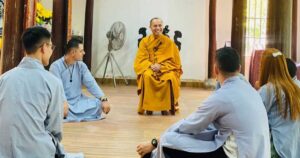
The Buddha did not teach us to have a careless mind, to be speechless, or without profession. The Buddha did not teach us to abandon everything in order to meditate. What the Buddha taught us is to think, speak, act, and work, but we must do so without making mistakes in Meditation and Mindful Living Tips for a Calm, Balanced Life. By doing so, we will have the merit to concentrate our mind in meditation.
Living without responsibility means we have no merit, no blessings. In terms of society, we are useless people, and according to the law of karma, we will gradually lose our blessings because we do nothing, but we still have to eat and breathe every day. In terms of religion, we belong to the category of breaking the teachings. Why do we break the teachings? Because we do not build the teachings and propagate the idea of not doing anything, then the teachings gradually decline. If we do not have responsibility for the teachings, we have no responsibility for the people, which is destructive. Not doing anything is a kind of destruction. The Buddha’s teachings are not about doing nothing, but about doing the right thing in Meditation and Mindful Living Tips for a Calm, Balanced Life .
-
How should we apply Meditation and Mindful Living Tips for a Calm, Balanced Life correctly when life is busy (if we need to work, organize, or calculate)

We completely dwell in our bodies, tranquil and content. And we always remember the impermanence of the body, knowing that the entire body is subject to change. If our work is stressful, we have a mind that knows the body. If our work is not stressful, we add the notion of impermanence to the body. And if there is no work, our breath naturally appears, similar to when we are in meditation. The same goes for when we sleep. Before sleeping, we may have certain aspirations, depending on each individual in Meditation and Mindful Living Tips for a Calm, Balanced Life, and then we dwell in our bodies, feeling the breath go in and out without controlling it.
-
When to practice meditation in Meditation and Mindful Living Tips for a Calm, Balanced Life?
Some people ask when they should meditate because they are too busy with their jobs and cannot sit still in meditation, unable to concentrate. They think they have to wait until retirement to start meditating in Meditation and Mindful Living Tips for a Calm, Balanced Life.
The answer is that nobody starts meditation with a calm mind right away. Whether you use the correct method or the wrong method, it will not yield any results; the mind will still be filled with distractions and illusions.

Over time, it might be months or even years, those who use the wrong method will become restless, and they may develop various illnesses. On the other hand, those who use the right method will begin to experience changes in consciousness, tranquility, and faith in Meditation and Mindful Living Tips for a Calm, Balanced Life.
Once you see the results, even if you are busy with work, you can still meditate with a focused mind. Therefore, don’t wait until all your work is done to start practicing mindfulness meditation; you should start as soon as possible, today or tomorrow. However, the most important thing is to find the right method, as making a mistake in this practice could lead to countless wandering lifetimes.

Meditation and Mindful Living Tips is a truly wonderful approach that helps you calm your mind, live more gently, and cultivate a more positive, compassionate way of living.
Related articles

Top must visit with low budget in Hanoi and Ho Chi Minh City
Vietnam is rapidly becoming one of the world’s leading destinations for mindful travel, offering meaningful experiences that go...
See more
Temple lodging – monastic life experience in Vietnam
Amid the pressure and fast pace of modern life, more and more people are seeking peaceful places to...
See more
Buddhism in Vietnam
Buddhism in Vietnam is one of the most influential religions in the country, shaping not only beliefs but...
See more
3 Distinctive Characteristics of Mindfulness Meditation Retreats in Vietnam
Mindfulness meditation retreats in Vietnam have grown rapidly in recent years and developed distinctive characteristics, blending traditional Buddhist...
See more
