
Buddha attained supreme enlightenment through meditation and then spent His whole life converting sentient beings. The Four Foundations of Mindfulness Sutra teaches a method of meditation to gain no-self, and to enter Nirvana.
3 best practice methods of mindfulness breathing exercises for anxiety
Mindfulness breathing exercises for anxiety can help calm the nervous system very quickly and effectively ease symptoms such as chest tightness, a racing heart, or dizziness caused by anxiety.
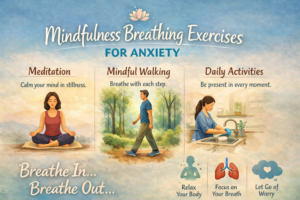
Below are simple and effective mindfulness breathing exercises that you can practice anywhere—no prior experience required.
1. Mindfulness breathing exercises for anxiety in mindfulness meditation
Mindfulness breathing practices for anxiety in mindfulness meditation is a highly effective method to reduce stress and anxiety, reconnect with oneself, and find inner peace through each breath and every moment of quiet sitting meditation.

Breath meditation techniques in Mindfulness breathing exercises for anxiety are extremely important for those who practice Buddhist meditation. Breathing is the core of meditation, anyone who practices meditation must understand the meaning of breathing very well.
Let’s explore 3 Important methods in Breath Meditation Techniques.
-The Basic
-The Wise
-The Smart
-
The Basic meditation Breathing method in mindfulness breathing exercises for anxiety
The Basic Breathing method in Breath meditation techniques is passively discerning breaths without controlling or interfering. Ones just observe their breaths without trying to breathe.
Most practitioners find it very difficult in discerning their breaths at the beginning because they keep trying to breathe whenever they pay attention to their breaths.
Thus, the more they do that, the more uncomfortable that they feel – both physically and mentally in Breath meditation techniques. Fortunately enough, Buddha taught and emphasized heavily in the Basic Breathing pattern in Nikaya:
-Breathing in deeply, I know that I am breathing in deeply. Breathing out deeply, I know that I am breathing out deeply.
-Breathing in shortly, I know that I am breathing in shortly. Breathing out shortly, I know that breathing out shortly.
Thus, the basic breathing method in Buddhist Breath meditation techniques is to simply Know and Notice ones’ breaths without deliberately making them longer or shorter, deeper or lighter. This is a stepping stone for practitioners to master the more advanced skill of “Discerning breaths” in meditation later on. Knowing without Controlling Breaths requires a sophisticated and advanced cognitive skill.
Mastering this skill makes ones become much more mindful and aware, especially the states of mind. When the mind is uncalm and disturbed, the breaths will be rushing, heavy, and uncomfortable. When the mind is calm and free of disturbance, the breaths will be light, slow, and relaxing. Just by observing the breaths, one can understand the states of their mind. When ones understand the states of their mind, they will be able to adjust their breaths accordingly.

-
The Wise meditation Breathing method in mindfulness breathing exercises for anxiety
When ones understand the states of their mind, they will be able to adjust their breaths accordingly. That leads to the Wise breathing pattern in Breath meditation techniques, which is built upon the Basic Breathing Method and the experience of many practitioners. From the basic breathing method, many practitioners have observed the relationship between the breath and mind, and they have realized that the deep breath helps to calm the mind down. From that realization, they have added one higher step to the basic breathing method in , which we would call the “the Wise Breathing Method” in Breath meditation techniques
-Breathing-in (Inhaling) lightly, calmly, and shortly.
-With hold the breaths for a little bit (if possible, ones could hold their breaths 3 times longer than inhaling)
-Breathing-out (Exhaling) slowly, up to five times longer than inhaling.

The Wise Breathing method makes it much faster for practitioners to attain a calmer and concentrated mind. From this breathing pattern, many practitioners are able to shut down all of their aimless thoughts and disturbances inside. Once again, the wise breathing method is built upon the basic. So if ones do not master the basic breathing method, it is almost impossible for them to cultivate the next step in Breath meditation techniques!
When using the breaths to concentrate the mind, Breathing-Out (Exhaling) is the key. However, in order to breathe out, ones must breathe in first (obviously!). Thus, ones have to breathe in shortly and slightly but still enough air to exhaling 5 times longer. Besides inhaling and exhaling, withholding breaths for a little bit could be beneficial to ones’ physical health and will also help them be more patient from the practice of not rushing to breathe out immediately.
-
The Smart meditation Breathing Method in mindfulness breathing exercises for anxiety
Lastly, it is the Smart Breathing Method – the inheritance and combination of Basic and Wise Breathing methods. Smart Breathing Method in Breath meditation techniquesis carefully evaluating each breath in and out and seeing if the length and depth of each breath are appropriate enough based on the state of mind.
This requires practitioners to be much more concentrated, careful, sophisticated, and smart to evaluate each of their breaths in every split-second. Still, they have to ensure that exhalation is always longer than inhalation, but each breath is different from one another.
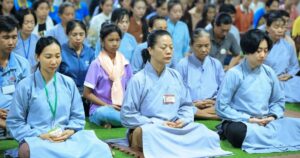
The length and depth of each breath should be based on the state of mind at that very moment. Based on the state of minds, practitioners evaluate and judge and adjust their breaths accordingly and appropriately. If they notice that their mind is currently like this, then inhaling this much is good enough, withholding this much is fair enough, and inhaling this long is reasonable enough.
There is no exact method to count how many seconds that one breath should take; it is all based on the current state of practitioners’ minds in Breath meditation techniques. Each breath is a different case; however, exhaling has to be always longer than inhaling!
Observing ones’ breaths and minds every single split-second and evaluate how appropriate they are – require the higher level of intelligence and wisdom. When practitioners get to this point and practice this level of breathing method, they actually become smarter and wiser in daily life. They are able to look at many things in life with greater depth and insight.
Though there is no solid instruction to breathe correctly in meditation, the right way is always to breath calmly and lightly, without moving the body much (especially the abdominal/belly area). Later on in higher stages, though still breathing, there is absolutely no movement that happens in practitioners’ bodies. Many Buddhist schools have taught the method of observing the inflation and deflation of the abdomen in Breath meditation techniques. Though it is not the most correct way to breathe in Buddhist Mindfulness Meditation, it is still considered as a basic Qi-gong exercise to concentrate ones’ vital force in their abdominal area.

When the three breathing methods in Buddhist Breath meditation techniques are applied correctly—together with the cultivation of moral conduct through many wholesome deeds, diligent practice of qigong, and unwavering, absolute reverence for the Buddha—the practitioner will experience clear and wondrous transformations in their spiritual practice.
2. Mindfulness breathing practices for for anxiety during mindful walking
Mindfulness breathing practices for for anxiety during mindful walking combines movement with deep awareness of the present moment. By focusing on the sensation of the feet touching the ground, the rhythm of the breath, and the surrounding environment, this practice helps reduce stress, enhance concentration, and cultivate a sense of peace in every step.
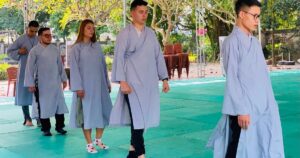
How to practice mindful walking in mindfulness breathing exercises for anxiety
- Walk slowly: Move more slowly than usual to more easily sense and feel your body.
• Focus on bodily sensations: Pay attention to the sensations in the soles of your feet, muscle movements, heartbeat, and body temperature as you move. Place the heel down first, then gently lower the entire foot. Keep your steps neither too long nor too short—just natural and balanced.
• Connect with the breath: Synchronize your breathing with each step, gently being aware of every in-breath and out-breath without trying to control it.
• Observe the five senses: Take in the surrounding scenery, listen to sounds, feel the breeze on your skin, and notice natural scents.
• Return to the present moment: If the mind wanders (to work, plans, or worries), gently bring your attention back to the sensations of the feet, the whole body, and the breath, recognizing the body as it is, shaped by habit and ignorance.
• Set an intention: Choose a period of time (5–30 minutes) for practice. This can be done while walking in a park, along a corridor, or during a quiet stroll.
3. Mindfulness breathing practices for for anxiety in daily activities
In addition to practicing mindfulness breathing while sitting meditation or mindful walking in mindfulness breathing exercises for anxiety, you can also practice mindfulness breathing during everyday activities such as cooking rice, washing dishes, cleaning the house, or working at the office.

Simply be aware of your gentle in-breath and out-breath without trying to control them, notice what your body is doing, and observe what is happening in the external environment. In this way, you will be able to focus better and avoid distractions while working.
As a result, your work efficiency will improve, and you will reduce stress, tension, and anxiety that have built up over a long period of time. Mindfulness breathing exercises for anxiety is extremely effective and can be applied in any situation. Take time to practice and build a daily habit of mindful breathing to bring the best benefits to your brain and mind.
Related articles
Top must visit with low budget in Hanoi and Ho Chi Minh City
Vietnam is rapidly becoming one of the world’s leading destinations for mindful travel, offering meaningful experiences that go...
See more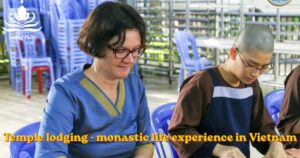
Temple lodging – monastic life experience in Vietnam
Amid the pressure and fast pace of modern life, more and more people are seeking peaceful places to...
See more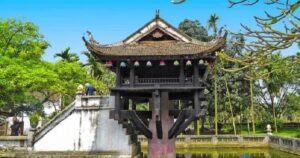
Buddhism in Vietnam
Buddhism in Vietnam is one of the most influential religions in the country, shaping not only beliefs but...
See more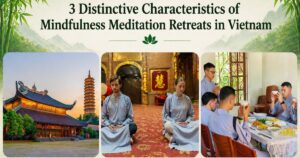
3 Distinctive Characteristics of Mindfulness Meditation Retreats in Vietnam
Mindfulness meditation retreats in Vietnam have grown rapidly in recent years and developed distinctive characteristics, blending traditional Buddhist...
See more
