
Buddha attained supreme enlightenment through meditation and then spent His whole life converting sentient beings. The Four Foundations of Mindfulness Sutra teaches a method of meditation to gain no-self, and to enter Nirvana.
Where are the 3 day / 5 day meditation retreat Vietnam held?
3 day / 5 day meditation retreat Vietnam are often organized regularly at large Buddhist temples in Northern Vietnam or at peaceful pagodas located deep in the forests and mountains of Southern Vietnam, surrounded by lush trees and clear, flowing streams. These longer meditation retreats offer an in-depth experience of meditation practice and Buddhist teachings for those seeking moments of inner peace and reflection, as well as a deeper understanding of meditation to apply in daily life and create positive changes. Let’s explore where 3 day / 5 day meditation retreat Vietnam are held!

1. 3 day / 5 day Meditation Retreat Vietnam are held at Tam Chuc Pagoda, Ha Nam
Tam Chuc Pagoda is located in Ba Sao Town, Kim Bang District, Ha Nam Province, about 60–70 km from the center of Hanoi. The Tam Chuc complex is considered one of the largest Buddhist pagoda complexes in the world, covering approximately 5,100 hectares.
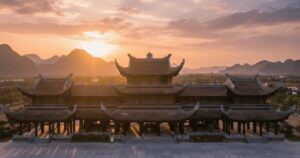
Nestled within a magnificent natural landscape of limestone mountains, vast lakes, and lush greenery, Tam Chuc is often described as “Ha Long Bay on land.” With its breathtaking scenery and grand architectural system, the pagoda has become one of the most remarkable spiritual destinations in Northern Vietnam, attracting millions of pilgrims and visitors each year.
Tam Chuc Pagoda is also regarded as an important Buddhist center forming a sacred spiritual axis that connects Huong Pagoda (Hanoi) – Tam Chuc Pagoda (Ha Nam) – Bai Dinh Pagoda (Ninh Binh).
The site has hosted many major international Buddhist events, most notably the United Nations Day of Vesak 2019, which welcomed thousands of Buddhist leaders and followers from more than 100 countries and territories.
At Tam Chuc Pagoda, 3 day / 5 day meditation retreat Vietnam are often organized based on group reservations. Participants stay within the pagoda grounds and take part in meaningful spiritual activities throughout the retreat.
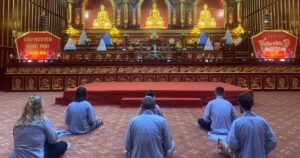
– Daily Spiritual Activities in the 3 day / 5 day meditation retreat Vietnam
During the retreat, participants engage in various Buddhist practices, including:
- Bowing to the Buddha to express deep gratitude and respect for the Buddha who discovered the path to enlightenment for all beings.
- Chanting sacred Buddhist sutras, such as:
- Compassion and Repentance Sutra
- Buddhist Daily Chant
- The Four Foundations of Mindfulness Sutra
- The Sutra of the Eightfold Path
- The Non-Self Sutra
Participants will practice:
- Walking meditation in the peaceful pagoda surroundings
- Tea meditation, learning to be present and mindful in each moment
- Lotus-position meditation (full-lotus sitting), one of the core practices in the 3 day / 5 day meditation retreat Vietnam.
These experiences allow participants to develop mindfulness, deepen their understanding of Buddhist teachings, and bring greater peace and clarity into daily life.
– Meditation Practice in 3 day / 5 day meditation retreat Vietnam
Meditation is a central part of the retreat. The basic meditation technique in 3 day / 5 day meditation retreat Vietnam
First, sit in the full lotus position.
Second, keep the body still and relaxed.
Third, abide in the body and be aware of all of it.
Fourth, contemplate the impermanence of the body.
Fifth, notice (but do not control) your breathing in and out.
These five things are all effective in resolving our unwanted thoughts. The principle of practicing meditation is to use a combination of many things to purify the mind. We must memorize and practice all these things.
+ The first is to sit in the full lotus position (all Buddhas of the past, the present, and the future, do it). You sit upright with your shoulders level and comfortable, place your left hand in your right hand, palms upwards. At that time, your two soles, two palms, and lower abdomen (with the CV4 Acupuncture Point inside) are considered to be located in the same place, corresponding to the five parts of the mind: one part for the lower abdomen, two parts for two palms, and two parts for two soles. Only in the full lotus position, can these five parts of the mind be gathered together? The heart and the head do not count as parts of the mind in practicing meditation.
+ The second is to keep the body still and relaxed. If the body is stiff, the brain will be tense; if the body isn’t still, the mind cannot be calmed. Therefore, keeping the body still and relaxed means keeping the mind calm (= to have fewer unwanted thoughts). Following Buddha’s path, we should treat the body as the root of the mind, and it’s the golden rule of the practice of meditation. Later, when we progress in meditation, we will find that we should never leave the body, at the beginning as well as at the end of our spiritual practice.
+ The third is to abide in the body and be aware of all of it. When we pay much attention to the body, the brain will be less active. So, abiding in the body and being aware of all of it is a powerful technique to quiet the mind, subduing strong unwanted thoughts. Don’t pay attention to the outside world but the whole body, from head to toe. Always correct the position of all parts of the body. Though you should be aware of the whole body, pay more attention to the abdomen (especially the bottom of the abdomen where the CV1 Acupuncture Point is located) and the legs and feet. We should be aware of it gently but not forcefully. The CV1 Acupuncture Point is located at the bottom of the abdomen but is responsible for the head. When it is strong, the brain will work very well, and thus we will become more intelligent and be easier to see our hidden mistakes, and after a long time, we will have intuition.
Besides, we need inner strength or inner power (from our practice of qigong) to be able to abide in the body and be aware of the whole body regularly. Those who possess great inner strength always feel their life energy, so they’re easy to remember their whole bodies. Inner strength helps nourish the brain.
Practicing qigong is to strengthen the part of the body from the navel down to the bottom of the abdomen, where there are three extremely important points: the CV4 Acupuncture Point, the CVI Acupuncture Point, and the sacral. The sacrum is the yin root of the body, the place where one’s inner strength is located and grown.
At the beginning of the practice of meditation, we were instructed “sit in the full lotus position; keep the body still and relaxed; abide in the body and be aware of it,” now you should be gently aware of the sacrum also (right at the sacrum, no higher that). Our inner power will gradually appear and it will support our practice of meditation.
+ The fourth is to contemplate the impermanence of the body. When we’re well aware of our bodies, our
minds will have few unwanted thoughts our bodies will be stable, and our inner strength will be full, and thus, our attachment to the body will appear. Being attached to the body is also being attached to the self, and that’s why Buddha teaches us to contemplate the impermanence of the body, setting up the foundation to eliminate the self.
In the Kayagatasati-Sutta, Buddha carefully teaches how to contemplate the body: the practitioner must see the change of the body from young to old, ugly, and sick, and then die, and then the body continues to decay, its bones also dissolve into ashes, then the ashes completely disappear. We have to do it to totally remove our attachment to the body. You see, Buddha’s thoroughness, rigor, subtlety, wisdom, and compassion are incomparable, and thus our reverence for Him will be never sufficient.
+ The fifth is to notice (but not control) your breathing in and out.
Breathing is the core of meditation, anyone who practices meditation must understand the meaning of breathing very well.
We breathe to sustain our lives, and breathing has two kinds: automatic breathing and active breathing. Automatic breathing means that even though we are not paying attention to our breathing, our bodies still breathe automatically, controlled by the unconscious nervous system. If we pay attention to our breathing (active breathing), it will immediately be controlled by the conscious nervous system.
Neuroscience has confirmed that when we breathe consciously (active breathing), our brains will immediately be focused and have few unwanted thoughts. This is a great property of man. In terms of medicine, we can say when the neural area responsible for breathing gets excited, other neural areas will go into inhibition.
Three solid foundations of meditation in 3 day / 5 day meditation retreat Vietnam
Alongside this, in order for our practice of meditation to be successful, we must first prepare three solid foundations: morality, blessings, and qigong.
Morality is the purity of the mind, with solute reverence for Buddha, boundless love for sentient beings, and extreme humility.
+ Blessings come from our efforts to bring peace, happiness, and morality to everyone.
+ Qigong helps to keep our life energy in the lower part of the body, helping the brain to be stable when we practice meditation.
– Sightseeing activities, exploring Buddhist culture, and listening to Dharma teachings during the 3 day / 5 day meditation retreat Vietnam.
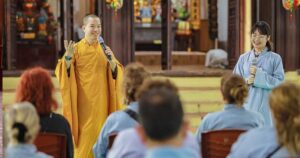
During the 3 day / 5 day meditation retreat Vietnam, you will be guided by experienced guides who will introduce you to the Buddhist culture and history of Tam Chuc Pagoda while taking you to visit many of the pagoda’s most famous sites. In addition to sightseeing, participants will also take part in meaningful learning activities related to Buddhist philosophy and the Law of Karma. These may include activities such as Karma puzzle matching, sutra copying, and Dharma talks, where teachers share Buddhist teachings and wisdom.
You will also have the opportunity to ask questions and discuss personal life concerns, receiving guidance on how to understand and resolve challenges in a more positive and mindful way according to the Law of Cause and Effect (Karma). These sessions help participants gain deeper insight, cultivate compassion, and apply Buddhist principles to everyday life.
2. 3 Day / 5 Day Meditation Retreat Vietnam at Bai Dinh Pagoda, Ninh Binh
Bai Dinh Pagoda is the largest Buddhist spiritual complex in Vietnam, located within the famous Trang An Scenic Landscape Complex, a UNESCO World Heritage site. The complex beautifully combines a 1,000-year-old ancient pagoda from the Dinh–Ly dynasties with a newly built pagoda area of monumental scale.
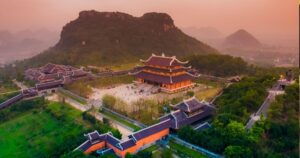
Bai Dinh Pagoda is well known for its magnificent Buddhist architecture and several Asian records, including giant golden Buddha statues, the longest corridor of Arhat statues, and one of the tallest Buddhist stupas in Asia.
Highlights of Buddhist Heritage and Architecture at Bai Dinh Pagoda
- Ancient history: The pagoda dates back to the Dinh–Ly dynasties and is closely associated with the Zen master Nguyen Minh Khong, who discovered the caves and transformed them into sacred spaces for worshiping the Buddha and local deities.
- The Ancient Pagoda Area: This historic section includes sacred sites such as the Buddha Cave, Bright Cave, Dark Cave, and Jade Well, where people worship Cao Son God, Saint Nguyen, and the Mother Goddess.
- The New Pagoda Complex (built from 2003): This large architectural complex features impressive halls such as the Tam The Hall, Dharma Lord Hall, Avalokitesvara Hall, the Bai Dinh Stupa, and the famous Corridor of 500 Arhat Statues.
- Asian and Vietnamese records: Bai Dinh Pagoda holds several notable records, including the largest bronze Maitreya Buddha statue in Southeast Asia, the largest gold-plated bronze Buddha statue in Asia, and the longest Arhat statue corridor in Asia.
Today, Bai Dinh Pagoda is one of the most important spiritual tourism destinations in Vietnam, welcoming millions of pilgrims and visitors every year who come to pray for peace, explore Vietnamese Buddhist culture, and admire its remarkable architecture.
Experience the 3 day / 5 day meditation retreat Vietnam at Bai Dinh Pagoda:
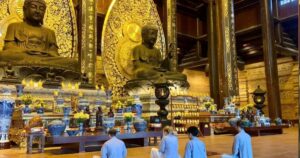
When joining a 3 day / 5 day meditation retreat Vietnam at Bai Dinh Pagoda, participants can experience a unique combination of spiritual practice and cultural exploration.
During the retreat, you may:
- Discover the magnificent architecture and long history of Bai Dinh Pagoda
- Take part in daily spiritual rituals and meditation sessions to better understand Buddhism and mindfulness practice
- Visit nearby attractions such as Trang An Scenic Landscape Complex, combining spiritual retreat with nature exploration
- Experience peaceful days of meditation, reflection, and inner healing
These spiritual travel experiences allow participants to slow down, let go of daily worries, reconnect with themselves, and reflect on life through the wisdom of Buddhist teachings and the Law of Karma. The retreat offers a peaceful journey where the mind becomes calmer and clearer, helping participants find meaningful ways to overcome life’s challenges with greater understanding and compassion.
3. 3 Day / 5 Day Meditation Retreat Vietnam at Yen Tu, Quang Ninh
Yen Tu Mountain is considered the cradle of Truc Lam Zen, a uniquely Vietnamese Buddhist meditation tradition founded in the 13th century by Tran Nhan Tong. Located in Uong Bi, Yen Tu is famous for its sacred atmosphere, majestic landscapes, and the iconic Dong Pagoda, a bronze pagoda situated at an altitude of 1,068 meters on the mountain summit.
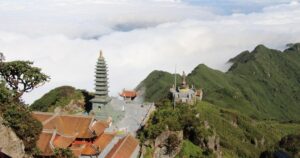
For centuries, Yen Tu has been regarded as one of the most important spiritual centers in Vietnam, attracting thousands of pilgrims and visitors each year who come to practice meditation, pray, and explore the heritage of Vietnamese Buddhism.
Highlights of Yen Tu Buddhism
- Founder and history: After abdicating the throne, Emperor Tran Nhan Tong chose Yen Tu Mountain as his place of spiritual practice and established Truc Lam Zen Buddhism, a Vietnamese Zen tradition that emphasizes meditation and engagement with everyday life.
- The Three Patriarchs of Truc Lam Zen: The tradition was developed and spread by the three great masters known as the Tam To Truc Lam:
- Tran Nhan Tong
- Phap Loa
- Huyen Quang
- Important sacred sites at Yen Tu:
- Dong Pagoda: The highest pagoda on the mountain, cast entirely from bronze and weighing more than 70 tons, dedicated to the Buddha.
- Truc Lam Yen Tu Zen Monastery (Lan Pagoda): A center for Buddhist learning and meditation practice.
- Ngoa Van Pagoda: The place where King Tran Nhan Tong is believed to have attained enlightenment.
- Trinh Pagoda: The traditional gateway where pilgrims begin their sacred journey to Yen Tu.
Beyond its religious significance, Yen Tu is also an important cultural and historical heritage site, preserving architectural and artistic values from the Tran, Le, and Nguyen dynasties, and symbolizing the virtues of patience, compassion, and spiritual awakening.
Experience a 3 Day / 5 Day Meditation Retreat Vietnam at Yen Tu
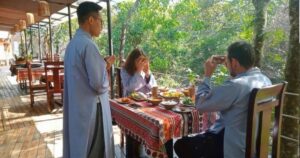
Today, Yen Tu has become one of the most meaningful destinations for spiritual tourism and meditation retreats in Vietnam. When joining a 3 day / 5 day meditation retreat Vietnam at Yen Tu, participants can experience a deeper journey into Buddhist practice and mindfulness.
During the retreat, participants may take part in:
- Seated meditation and walking meditation in the peaceful mountain environment
- Bowing to the Buddha, chanting sutras, and repentance ceremonies
- Food offering rituals and spiritual practices following Buddhist traditions
- Exploring Yen Tu Mountain and visiting sacred pagodas along the pilgrimage route
- Dharma talks and discussions to better understand Buddhist philosophy
- Vegetarian cooking classes, learning how to prepare nourishing plant-based meals
These multi-day retreats offer a profound opportunity to connect with the teachings of Buddhism, practice mindfulness, and experience inner peace. Surrounded by the serene mountains and forests of Yen Tu, participants can temporarily leave behind the stresses of daily life, rediscover themselves, and find a path toward greater wisdom, compassion, and true happiness.
4. 3 Day / 5 Day Meditation Retreat Vietnam at Dinh Mountain, Vung Tau
Dinh Mountain is a well-known spiritual destination in Southern Vietnam, home to many pagodas and monasteries hidden among the majestic mountains and forests. One of the most famous pagodas here is Thien Ton Phat Quang Pagoda, making the area an ideal place for visitors seeking meditation, spiritual learning, and peaceful reflection in nature.
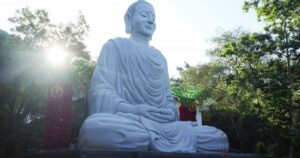
Highlights of Buddhism at Dinh Mountain
- Thien Ton Phat Quang Pagoda (Phat Quang Pagoda)
- Location: Situated on Dinh Mountain in Chu Hai Village, Tan Hai Commune, Phu My.
- Atmosphere: The pagoda is surrounded by lush forests and fresh mountain air, creating a calm and tranquil environment that is perfect for meditation retreats and large Buddhist ceremonies.
- Special landmark: The pagoda features an impressive 14-meter statue of Shakyamuni Buddha, symbolizing serenity and compassion.
Visitors often come to Dinh Mountain to walk through forest trails, visit pagodas, admire sunrise or sunset from the mountain, and participate in Buddhist ceremonies or meditation retreats.
Experience the 3 Day / 5 Day Meditation Retreat Vietnam at Dinh Mountain
When joining a 3 Day / 5 Day Meditation Retreat Vietnam at Dinh Mountain, participants will experience not only spiritual practices but also the simple daily lifestyle of a Buddhist monastery.
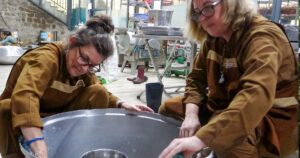
Besides meditation and spiritual activities similar to other retreats, participants may also take part in mindful daily work, such as:
- Washing dishes
- Preparing vegetarian meals
- Making traditional vegetarian cakes
- Sewing or simple handicrafts
- Planting trees and gardening
Through these activities, participants gain a deeper understanding of the simple, compassionate, and mindful lifestyle practiced by Monks and Nuns at the pagoda.
The 3 day / 5 day meditation retreat Vietnam provides a deeper experience of meditation practice and Buddhist teachings, helping participants apply mindfulness and wisdom to everyday life. By learning and practicing these teachings, many people find a more positive way of living—with greater compassion, less stress, and a deeper sense of peace and happiness.
Join the retreat and experience this meaningful spiritual journey for yourself.
Related articles
Top must visit with low budget in Hanoi and Ho Chi Minh City
Vietnam is rapidly becoming one of the world’s leading destinations for mindful travel, offering meaningful experiences that go...
See more
Temple lodging – monastic life experience in Vietnam
Amid the pressure and fast pace of modern life, more and more people are seeking peaceful places to...
See more
Buddhism in Vietnam
Buddhism in Vietnam is one of the most influential religions in the country, shaping not only beliefs but...
See more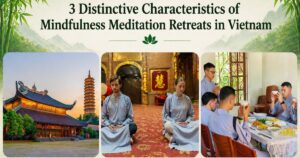
3 Distinctive Characteristics of Mindfulness Meditation Retreats in Vietnam
Mindfulness meditation retreats in Vietnam have grown rapidly in recent years and developed distinctive characteristics, blending traditional Buddhist...
See more
