
Buddha attained supreme enlightenment through meditation and then spent His whole life converting sentient beings. The Four Foundations of Mindfulness Sutra teaches a method of meditation to gain no-self, and to enter Nirvana.
3 most common types of spiritual retreats Vietnam
Spiritual retreats Vietnam are commonly held at pagodas from the North to the South, offering a peaceful environment for cultivating the mind and inner well-being. These retreats often include activities such as sitting meditation, Dharma talks, and mindfulness practices. They may be either free of charge or require a fee, depending on the type of retreat. Let’s explore the three most common types of spiritual retreats in Vietnam!
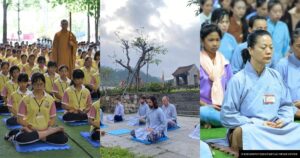
1. Summer Retreats for Youth in Spiritual Retreats Vietnam
Summer retreats for youth in Spiritual Retreats Vietnam are a popular form of Buddhist experiential program in Vietnam (usually lasting 7–30 days) designed to nurture the mind, build moral values, and develop life skills for students and young people. These retreats encourage participants to step away from digital devices and social media, creating a healthy and mindful environment. Most of these retreats are free of charge and focus on teachings of compassion, meditation practice, community responsibility, and essential life skills, helping young people cultivate kindness and positive values.

Key features and content of summer youth retreats in spiritual retreats Vietnam:
-
Purpose of summer youth retreats in spiritual retreats Vietnam:
These retreats help students and young people reduce negative habits such as excessive phone use or following unhealthy trends on social media. They aim to build good character, cultivate wisdom, and encourage positive thinking.
-
Content of summer youth retreats in spiritual retreats Vietnam:
Participants study basic Buddhist teachings, listen to Dharma talks, and practice meditation. They also learn practical life skills such as fire safety, first aid for injuries or drowning, how to prevent accidents or kidnapping situations, and how to take care of themselves and support their families. In addition, the retreats promote patriotism, respect for teachers and elders, appreciation for people with great contributions or moral values, and encourage sharing love and kindness with family and friends. Group activities and skill-building games are also included.
-
Rules of summer youth retreats in spiritual retreats Vietnam:
Participants are not allowed to use mobile phones, must wear the retreat uniform, follow a vegetarian diet with three meals per day, and adhere to the daily schedule for waking up and going to bed.
These retreats provide a valuable opportunity for teenagers and young people to cultivate inner peace, develop good character, and strengthen their spiritual foundation during the summer, helping them grow into responsible and compassionate individuals for society.
2. Mindfulness Meditation Retreats in Spiritual Retreats Vietnam
a. Duration of Mindfulness Meditation Retreat Vietnam in Spiritual Retreats Vietnam
Mindfulness Meditation Retreat Vietnam in Spiritual Retreats Vietnam is very flexible in terms of duration. Retreat range from half-day and one-day programs to 2–3 days or even longer, making them suitable for both complete beginners and those who already have some familiarity with meditation and Buddhism.

This flexibility also makes it convenient for travelers visiting Vietnam, as they can easily combine work, business trips, sightseeing, and retreat participation in a practical and accessible way.
b. Activities in Mindfulness Meditation Retreat Vietnam in Spiritual Retreats Vietnam
There are many meaningful activities offered in Mindfulness Meditation Retreat Vietnam in Spiritual Retreats Vietnam, allowing any participant to practice and apply what they learn in daily life.
-
Spiritual Rituals in Mindfulness Meditation Retreat Vietnam in Spiritual Retreats Vietnam
In Buddhism, there are many meaningful spiritual rituals that take place in pagodas and monasteries, or are practiced daily at home by lay Buddhists.
These include the ritual of bowing to the Buddha as a heartfelt expression of reverence and gratitude—honoring the Buddha for coming into this world and tirelessly seeking the path to complete liberation, bringing true happiness to humanity. There are also prayers for world peace and aspirations for everyone to live better, more wholesome lives.
Another essential practice in Mindfulness Meditation Retreat Vietnam in Spiritual Retreats Vietnam is chanting sacred sutras—profound teachings left by the Buddha for the world—and applying those teachings to our present daily lives. These may include Compassion and Repentance Sutra, the Buddhist Daily Chant, The Four Mindfulness Foundations Sutra, The Sutra of the Eightfold Path, and the Non-Self Sutra, among others.
-
Sitting Meditation in Mindfulness Meditation Retreat Vietnam in Spiritual Retreats Vietnam
The basic meditation technique in Mindfulness Meditation Retreat Vietnam in Spiritual Retreats Vietnam

First, sit in the full lotus position.
Second, keep the body still and relaxed.
Third, abide in the body and be aware of all of it.
Fourth, contemplate the impermanence of the body.
Fifth, notice (but do not control) your breathing in and out.
These five things are all effective in resolving our unwanted thoughts. The principle of practicing meditation is to use a combination of many things to purify the mind. We must memorize and practice all these things.
+ The first is to sit in the full lotus position (all Buddhas of the past, the present, and the future, do it). You sit upright with your shoulders level and comfortable, place your left hand in your right hand, palms upwards. At that time, your two soles, two palms, and lower abdomen (with the CV4 Acupuncture Point inside) are considered to be located in the same place, corresponding to the five parts of the mind: one part for the lower abdomen, two parts for two palms, and two parts for two soles. Only in the full lotus position, can these five parts of the mind be gathered together? The heart and the head do not count as parts of the mind in practicing meditation.
+ The second is to keep the body still and relaxed. If the body is stiff, the brain will be tense; if the body isn’t still, the mind cannot be calmed. Therefore, keeping the body still and relaxed means keeping the mind calm (= to have fewer unwanted thoughts). Following Buddha’s path, we should treat the body as the root of the mind, and it’s the golden rule of the practice of meditation. Later, when we progress in meditation, we will find that we should never leave the body, at the beginning as well as at the end of our spiritual practice.
+ The third is to abide in the body and be aware of all of it. When we pay much attention to the body, the brain will be less active. So, abiding in the body and being aware of all of it is a powerful technique to quiet the mind, subduing strong unwanted thoughts. Don’t pay attention to the outside world but the whole body, from head to toe. Always correct the position of all parts of the body. Though you should be aware of the whole body, pay more attention to the abdomen (especially the bottom of the abdomen where the CV1 Acupuncture Point is located) and the legs and feet. We should be aware of it gently but not forcefully. The CV1 Acupuncture Point is located at the bottom of the abdomen but is responsible for the head. When it is strong, the brain will work very well, and thus we will become more intelligent and be easier to see our hidden mistakes, and after a long time, we will have intuition.
Besides, we need inner strength or inner power (from our practice of qigong) to be able to abide in the body and be aware of the whole body regularly. Those who possess great inner strength always feel their life energy, so they’re easy to remember their whole bodies. Inner strength helps nourish the brain.
Practicing qigong is to strengthen the part of the body from the navel down to the bottom of the abdomen, where there are three extremely important points: the CV4 Acupuncture Point, the CVI Acupuncture Point, and the sacral. The sacrum is the yin root of the body, the place where one’s inner strength is located and grown.
At the beginning of the practice of meditation, we were instructed “sit in the full lotus position; keep the body still and relaxed; abide in the body and be aware of it,” now you should be gently aware of the sacrum also (right at the sacrum, no higher that). Our inner power will gradually appear and it will support our practice of meditation.
+ The fourth is to contemplate the impermanence of the body. When we’re well aware of our bodies, our
minds will have few unwanted thoughts our bodies will be stable, and our inner strength will be full, and thus, our attachment to the body will appear. Being attached to the body is also being attached to the self, and that’s why Buddha teaches us to contemplate the impermanence of the body, setting up the foundation to eliminate the self.
In the Kayagatasati-Sutta, Buddha carefully teaches how to contemplate the body: the practitioner must see the change of the body from young to old, ugly, and sick, and then die, and then the body continues to decay, its bones also dissolve into ashes, then the ashes completely disappear. We have to do it to totally remove our attachment to the body. You see, Buddha’s thoroughness, rigor, subtlety, wisdom, and compassion are incomparable, and thus our reverence for Him will be never sufficient.
+ The fifth is to notice (but not control) your breathing in and out.
Breathing is the core of meditation, anyone who practices meditation must understand the meaning of breathing very well.
We breathe to sustain our lives, and breathing has two kinds: automatic breathing and active breathing. Automatic breathing means that even though we are not paying attention to our breathing, our bodies still breathe automatically, controlled by the unconscious nervous system. If we pay attention to our breathing (active breathing), it will immediately be controlled by the conscious nervous system.
Neuroscience has confirmed that when we breathe consciously (active breathing), our brains will immediately be focused and have few unwanted thoughts. This is a great property of man. In terms of medicine, we can say when the neural area responsible for breathing gets excited, other neural areas will go into inhibition.
Three solid foundations of meditation in Mindfulness Meditation Retreat Vietnam in Spiritual Retreats Vietnam
Alongside this, in order for our practice of meditation to be successful, we must first prepare three solid foundations: morality, blessings, and qigong.
+ Morality is the purity of the mind, with solute reverence for Buddha, boundless love for sentient beings, and extreme humility.
+ Blessings come from our efforts to bring peace, happiness, and morality to everyone.
+ Qigong helps to keep our life energy in the lower part of the body, helping the brain to be stable when we practice meditation.
-
Walking Meditation in Mindfulness Meditation Retreat Vietnam in Spiritual Retreats Vietnam
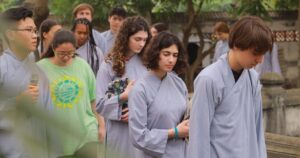
How to practice mindful walking in Mindfulness Meditation Retreat Vietnam in Spiritual Retreats Vietnam:
Walk slowly: Move more slowly than usual to more easily sense and feel your body.
Focus on bodily sensations: Pay attention to the sensations in the soles of your feet, muscle movements, heartbeat, and body temperature as you move. Place the heel down first, then gently lower the entire foot. Keep your steps neither too long nor too short—just natural and balanced.
Connect with the breath: Synchronize your breathing with each step, gently being aware of every in-breath and out-breath without trying to control it.
Observe the five senses: Take in the surrounding scenery, listen to sounds, feel the breeze on your skin, and notice natural scents.
Return to the present moment: If the mind wanders (to work, plans, or worries), gently bring your attention back to the sensations of the feet, the whole body, and the breath, recognizing the body as it is, shaped by habit and ignorance.
Set an intention: Choose a period of time (5–30 minutes) for practice. This can be done while walking in a park, along a corridor, or during a quiet stroll.
-
Experiencing Monastic Life or Staying in pagodas, Listening to Dharma Talks, and Learning Buddhist Teachings during Mindfulness Meditation Retreat Vietnam in Spiritual Retreats Vietnam
Experiencing monastic life or staying in pagodas during Mindfulness Meditation Retreat Vietnam in Spiritual Retreats Vietnam is a journey that helps you rediscover inner peace through practicing awareness in every activity. It also offers a deeper understanding of the simple, compassionate lifestyle of lay practitioners and monastics, allowing you to gain deeper insight into Vietnamese Buddhism.
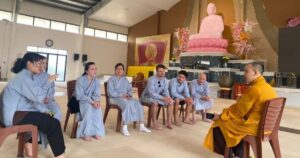
You will take part in daily activities ranging from spiritual ritual sessions to cooking, baking, gardening, community service work, offering food to sentient beings, and practicing life release to nurture compassion. Through these experiences, you can set aside the worries and pressures of modern life, return to yourself, dwell peacefully within, and learn to live with greater compassion, love, and generosity in accordance with the Buddha’s teachings.
In addition, Mindfulness Meditation Retreat Vietnam in Spiritual Retreats Vietnam often include Dharma talks—teachings given by Monks or Nuns who have ordained and trained in the pagoda. These talks help relieve stress, clarify the path of mental development, deepen your understanding of Buddhism, and guide you in living compassionately in everyday life. You may also join sharing sessions led by experienced Buddhist practitioners who provide practical guidance, answer life questions, and help you find a more wholesome direction for your life.
c. Accommodation and Meals in Mindfulness Meditation Retreat Vietnam in Spiritual Retreats Vietnam
Accommodation and meals in Mindfulness Meditation Retreat Vietnam in Spiritual Retreats Vietnam are usually simple, peaceful, and follow vegetarian principles. Participants typically stay in shared rooms or single rooms upon request, depending on the specific retreat’s regulations. The accommodation is often in a pagoda guesthouse or modest on-site lodging. You will be served three fully vegetarian meals per day at the pagoda, observe noble silence during designated periods, and focus entirely on cultivating mindfulness of body and mind.
-
Accommodation in Mindfulness Meditation Retreat Vietnam in Spiritual Retreats Vietnam
Rooms: Typically simple shared dormitory-style rooms (separated for men and women) or basic rooms in the temple guesthouse. Facilities are minimal to help participants focus on their practice and reduce distractions.
Environment: Quiet, nature-oriented surroundings, away from the noise and busyness of urban life. -
Meals in Mindfulness Meditation Retreat Vietnam in Spiritual Retreats Vietnam
Diet: 100% vegetarian meals that are light, simple, and nutritionally balanced to support your health during practice.
Principles: Meals are taken mindfully and in silence. Participants are encouraged not to overeat to avoid drowsiness during meditation sessions.
d. Language in Mindfulness Meditation Retreat Vietnam in Spiritual Retreats Vietnam
When joining a Mindfulness Meditation Retreat Vietnam in Spiritual Retreats Vietnam, you will be guided attentively in English by experienced instructors.

In addition to leading you through activities throughout the program, the instructors are also there to listen and share with you about the challenges you may be facing in life. They help you reflect and find solutions based on the Buddhist law of cause and effect (karma), supporting you in transforming your life toward a more positive, loving, and wholesome direction.
3. One-Day Mindfulness Retreats in Spiritual Retreats Vietnam
In addition to the in-depth mindfulness meditation retreats in in Spiritual Retreats Vietnam mentioned above, visitors can also experience free one-day meditation retreat cost Vietnam in cities such as Hanoi, Ho Chi Minh City, Hai Phong, and others. These meditation retreats in Vietnam are completely free of charge and open to people of all ages.

By joining these meditation retreats, participants will learn how to meditate at no cost and practice multiple meditation sessions throughout the day. In addition, they will take part in spiritual activities such as paying respect to the Buddha, chanting sutras in Vietnamese with English translations that are easy to understand, offering food to wandering spirits at the pagoda, enjoying vegetarian meals, practicing qigong, and listening to Monks and Nuns share Buddhist teachings.
It is truly a peaceful day of returning to oneself, realizing that this body and mind have committed many mistakes in past lives and in this life, and cultivating the intention to perform wholesome deeds, avoid unwholesome actions, and build a better and more meaningful life.
Spiritual retreats Vietnam are highly practical and grounded in scientific principles, helping participants transform their inner lives, change their thinking, and develop healthier and more compassionate ways of living. Come to Vietnam and experience a spiritual retreat for yourself!
Related articles
Top must visit with low budget in Hanoi and Ho Chi Minh City
Vietnam is rapidly becoming one of the world’s leading destinations for mindful travel, offering meaningful experiences that go...
See more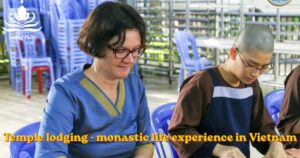
Temple lodging – monastic life experience in Vietnam
Amid the pressure and fast pace of modern life, more and more people are seeking peaceful places to...
See more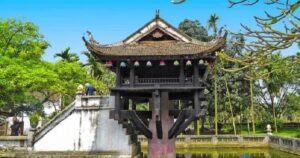
Buddhism in Vietnam
Buddhism in Vietnam is one of the most influential religions in the country, shaping not only beliefs but...
See more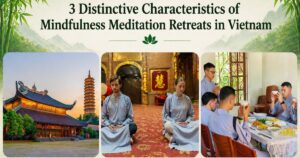
3 Distinctive Characteristics of Mindfulness Meditation Retreats in Vietnam
Mindfulness meditation retreats in Vietnam have grown rapidly in recent years and developed distinctive characteristics, blending traditional Buddhist...
See more
